


There is a moment almost everyone remembers, not fondly, when the excitement of getting a new car quietly dissolves into confusion. The questions pile up faster than the answers can be provided. The numbers don’t seem to add up. The clock keeps ticking. Somewhere between the first online search and the final signature, the experience stops feeling empowering and starts feeling adversarial.
This is the moment Thornebriar exists for, bridging the gap from confusion to control in car buying.
Thornebriar was not born from marketing theory or boardroom guesswork. It was founded by auto industry and technology professionals with more than 30 years of firsthand experience inside a system they knew was broken. They understood something most consumers only sense: car buying isn’t difficult because it’s complicated—it’s difficult because it’s intentionally opaque. Pricing is flexible. Information is fragmented. Incentives are buried. And the consumer is left to negotiate blind.
What Thornebriar offers is not a shortcut. It’s something far more radical: clarity. A structured way to take back control of the largest and most complex financial transaction most people will ever make outside of buying a home. Their tools don’t shout. They don’t pressure. They don’t promise magic. Instead, they quietly dismantle the imbalance that has defined car buying for decades.
To deliver this clarity, Thornebriar centers its strategy on two products that aim to change the car-buying experience from the inside out.

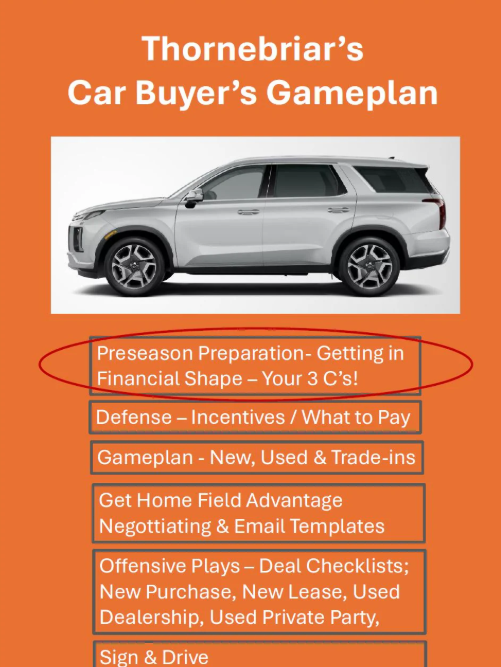
The Car Buyer’s Guide: The 3C’s Gameplan
A foundation before the first foot hits the lot.
Every successful journey begins before the road does. The Car Buyer’s Guide: The 3C’s Gameplan starts where most advice never does, before the shopping, before the negotiating, before the numbers. It begins with preparation.
The three C’s, Character, Capacity, and Collateral, sound deceptively simple. In reality, they are the same framework lenders and dealerships use to evaluate buyers. Thornebriar flips the lens and gives that framework back to the consumer.
Character is about creditworthiness, yes, but also about credibility. Understanding one’s own credit profile removes fear from the conversation. An interesting fact many buyers don’t realize is that dealers often assess how confident a customer seems about their credit before even pulling a report. Confidence changes outcomes.
Capacity focuses on affordability in a way that goes beyond monthly payments. The guide reframes the conversation around total cost, long-term financial health, and realistic budgeting. It dismantles the industry’s favorite illusion: that affordability is whatever fits into a monthly number stretched long enough.
Collateral addresses the vehicle itself, how lenders and dealers value it, how depreciation works, and why two identical cars can be treated very differently depending on timing and market conditions. Few consumers realize that vehicles depreciate fastest in the first year, yet incentives are often strongest during specific inventory cycles. Knowing this can shift leverage dramatically.
The Gameplan doesn’t overwhelm. It empowers. It gives buyers the mental footing they need to move forward without hesitation. Instead of reacting to the process, they begin to direct it.

Why Car Buying Still Feels Unfair
And why that’s not an accident.
There’s a simple question Thornebriar asks that most consumers never stop to consider: why does everyone pay the same price for a television, but not for a car?
The answer is uncomfortable. Dealers don’t price products, they price people.
Two buyers can walk into different dealerships, purchase identically equipped Toyota Camrys, and leave with wildly different deals. Not because of luck. Not because of timing. But because the system is designed to extract the maximum profit from each individual customer.
Free information hasn’t fixed this problem. In fact, it has quietly made it worse.
Much of what consumers believe is “free” online is paid for by manufacturers, dealers, lenders, and intermediaries. Pricing tools, comparison sites, and “insider” advice often come with a hidden cost: personal data. When a consumer requests pricing information, they aren’t just getting numbers, they’re becoming a sales lead. That lead is sold, resold, and pursued aggressively.
Thornebriar’s approach is different. Their tools are paid for by the consumer, and loyal to the consumer alone. No lead selling. No hidden agendas. No divided interests. This single distinction changes everything.
The Car Buyer’s Roadmap: Save Time. Save Money. Be Sure.
Turning complexity into sequence.
If the 3C’s Gameplan is preparation, the Car Buyer’s Roadmap is execution.
Where most buyers stumble is not a lack of effort, but a lack of order. They negotiate price before understanding incentives. They discuss financing before finalizing the total cost. They trade vehicles before locking in terms. Each misstep quietly erodes leverage.
The Roadmap restores order.
It lays out the entire transaction, from shopping to signing, as a sequence of deliberate steps. Each step builds on the one before it, ensuring nothing is left to chance or emotion.
One of its most powerful features is the Offer Generator, a simple but effective spreadsheet tool that helps buyers determine a realistic target price, an initial offer, and structured counteroffers. This isn’t guesswork. It’s math. And math is impartial.
Paired with negotiation email templates, the Roadmap enables something most buyers never attempt: remote negotiation. By removing face-to-face pressure, emotion, and time traps, consumers gain clarity and patience. Dealers, in turn, respond with real numbers rather than theatrics.
An interesting industry fact: dealerships often offer better pricing to remote, email-based buyers because the cost of selling to them is lower. Fewer hours. Fewer staff. Less friction. Thornebriar teaches buyers how to become that buyer.

Shopping Smarter, Not Harder
Using information, the way professionals do.
The Roadmap begins at the source: the manufacturer’s website. Not third-party listings. Not ads. The source.
Here, buyers learn to identify models, trims, options, and incentives with precision. This matters because pricing transparency disappears the moment ambiguity enters the conversation. A dealer can’t fairly price what isn’t clearly defined.
Thornebriar then introduces a surprisingly effective use of AI, not to negotiate, but to search. By copying a precise vehicle description, such as 2025 Toyota RAV4 LE AWD, and prompting AI to find inventory within a defined radius, buyers can quickly identify which dealerships actually have the car. This reveals something rarely discussed: supply pressure.
Dealers with aging inventory negotiate differently from those with one unit on the lot. Knowing this shifts the leverage before the first email is sent.
The Roadmap also teaches buyers who to contact, and who to avoid. Internet or online sales teams, fleet managers, and named contacts outperform generic inquiries every time. Specificity commands respect.
Negotiation Without the Noise
Where leverage quietly changes hands.
The Roadmap’s email-first strategy is where many buyers experience their first real sense of control. Instead of reacting to sales tactics, they solicit Out-the-Door (OTD) prices from multiple dealerships simultaneously.
OTD pricing is critical. It includes everything, vehicle price, taxes, fees, and add-ons. It prevents the classic bait-and-switch where a “great deal” grows expensive at signing.
By comparing real offers from three to five dealers, buyers create competition without confrontation. The lowest offer becomes leverage, not a final destination. It’s used to negotiate with the most convenient dealership, often local, ensuring both savings and service continuity.
Only after the price is finalized does financing enter the conversation. This sequencing alone can save thousands. Dealers often bundle financing margins into vehicle pricing. Separating them forces transparency.
The Roadmap even addresses trade-ins strategically, advising buyers to present existing offers and understand state-specific tax implications, an overlooked detail that can significantly impact net cost.
The Playbook That Ties It All Together
From preparation to peace of mind.
Both products are unified by Thornebriar’s Car Buyer’s Playbook, which includes:
Preseason Vital Signs: ensuring readiness through the 3 C’s
Incentives and What to Pay: Decoding Manufacturer Offers
New and Used Gameplans: tailored strategies for each market
Negotiation Email Templates: clarity without confrontation
Vehicle Transaction Checklist (VTC): a final safeguard against surprises
Checklists may sound mundane, but in complex transactions, they are powerful. Airline pilots use them. Surgeons rely on them. Car buyers deserve them.

A Different Perspective on Power
Why this information matters
What makes Thornebriar different is not just what they teach, but how they reframe the experience. Car buying doesn’t have to feel like combat. It can feel like navigation.
When consumers understand the system, the system loses its ability to intimidate. Knowledge doesn’t just save money, it restores dignity.
An often-overlooked fact is that buyers who feel confident report higher satisfaction with their vehicles months and even years later. The experience lingers. So does regret. Thornebriar aims to eliminate the latter.
The Quiet Advantage
Why those who know, know.
Thornebriar doesn’t promise the impossible. They promise something better: fairness, structure, and certainty in a process that rarely offers any of the three.
Their tools don’t replace thinking, they sharpen it. They don’t remove choice, they clarify it. And they don’t rush the buyer, they protect them from being rushed.
For anyone who has ever felt uneasy signing paperwork they didn’t fully understand, for anyone who suspects they paid more than they should have, and for anyone preparing to enter the car market again, this is information that changes outcomes.
Not because it’s loud.
Not because it’s flashy.
But because it finally puts the consumer back where they belong: in the driver’s seat.