


Most people have done this without really thinking about it.
You’re standing in the shower, half awake, holding a bottle of shampoo and staring at the back label like it might suddenly explain itself. You squint a little. You tilt the bottle closer to the light. You try to pronounce something that looks less like an ingredient and more like a chemistry experiment. Eventually you give up and think, “Well… it probably cleans hair.”
That used to be my entire relationship with shampoo.
Not a deep relationship. Not a thoughtful one. Just a practical little agreement: you clean my hair; I’ll stop asking questions.
But the older I get, the less convincing that arrangement feels. Maybe that happens to everyone eventually. One day you realize your bathroom shelf is full of products you bought quickly, used automatically, and barely thought about. They promised shine, volume, moisture, radiance, repair, bounce, glow, youth, and possibly emotional stability, and somewhere along the way you stopped believing half of it. You start wanting something simpler. Something that feels less like a marketing performance and more like actual care.
Hair has a funny way of pushing people toward that realization.
When life is calm, hair behaves like a pleasant roommate. It cooperates. It has a nice attitude. It catches the light in a flattering way and makes you feel like maybe you have your life together.
When life is not calm, hair becomes a tiny public relations crisis.
The ends feel dry for no reason. The scalp gets moody. Everything looks vaguely tired. Suddenly your reflection is giving away information you did not authorize it to share. Stress, weather, hormones, routine changes, not enough sleep, too much heat styling, one ill-advised experiment with a new product that smelled amazing but clearly had other plans for your head, hair keeps the receipts.
That’s when I start getting curious. Not in a dramatic “throw everything away and become a different person” kind of way.
More in the quiet way people do when they’re ready for gentler things.
A gentler routine. Gentler ingredients. A gentler sensory experience. Something that doesn’t feel like punishment disguised as self-care.
That line of thought is what led me to Linda Kammins Aromatherapy Beauty, and honestly, the brand story got my attention before the products even did. Because this wasn’t one of those beauty stories that feels assembled in a boardroom by people who discovered the word “botanical” three weeks ago. It felt personal. Lived in. Built over time.
And the more I learned about Shungite Shampoo and Luster Hair Oil, the more I felt like I was looking at a beauty line created by someone who has spent a very long time paying close attention.
The Kind of Beauty Story I Actually Believe
Some brand origin stories sound suspiciously polished.
A visionary founder. A market gap. A disruptive innovation. A sleek launch. Everyone in beige clothing.
This one feels more human than that.
Linda Kammins grew up in a family of artisans and was influenced by her Spanish-born grandmother, who taught her how to heal with herbs from the garden. I love details like that because they tell you something about the emotional architecture of a brand. Long before there were products and labels and pages to click through, there was already a worldview forming: plants matter, nature knows things, and care can be both practical and beautiful.
Then came beauty school, which should have been exciting and inspiring, except Linda walked into that environment and was hit with the sharp, toxic smells common in conventional beauty spaces. That reaction stayed with her. She didn’t just dislike it. She recoiled from it. And in that moment she promised herself she had to find a healthier way to stay on this path.
That promise became a career.
For thirty-three years, Linda owned Linda Kammins Aromatherapy Salon in Los Angeles, and during that time she researched and developed her Bio-Harmonic natural hair and skin care line.
I like that phrase, Bio-Harmonic, because it sounds poetic without being vague once you understand it. Bio means life. Harmonic means balance. That alone tells you a lot about the philosophy behind the line. These products aren’t framed as warfare against your hair or your skin. They’re not here to battle, strip, attack, erase, or obliterate. The goal is balance. Support. Working with the body instead of constantly trying to overpower it.
That feels refreshingly sane.

Hair Is Not a Floor You Scrub
I think one of the strangest things the beauty world ever did was convince people that “clean” has to feel aggressive.
If a face wash leaves your skin tight, people assume it’s working. If a shampoo foams like a detergent commercial, people assume it’s being thorough. If something tingles hard enough, half the population goes, Ah yes, science.
But hair is not a countertop. Your scalp is not a frying pan. And a lot of people eventually reach the point where they start wondering whether the whole scorched-earth approach is part of the problem.
That’s where Shungite Shampoo becomes interesting.
First, there’s the name. Shungite already sounds mysterious in the best possible way, like it belongs in either an ancient mineral collection or a particularly glamorous apothecary. And as it turns out, it really is unusual. Shungite is described by the brand as a two-billion-year-old carbon-rich mineral from Karelia, Russia, noted for rare carbon structures called fullerenes and appreciated for detoxification, antioxidant, and anti-inflammatory properties.
That is not your average shampoo ingredient story.
Most shampoos are lucky if they can make rosemary sound exciting. This one casually arrives with an ancient mineral and a geological backstory.
But what I find more compelling than the novelty is Linda’s reason for being interested in it. She wasn’t chasing a trend. She was intrigued by a unique mineral and how it might help keep hair healthier and more vibrant. That kind of curiosity tends to lead to more thoughtful formulations than trend-chasing ever does.
And the customer response included in the brand materials adds another layer. One customer describes the shampoo as almost “water activated,” noting that when it’s placed in the hands and mixed with water, it creates the right amount of suds without relying on SLS-heavy theatrics. I think that matters because so many of us have been trained to equate giant bubbles with effectiveness, when really that’s often just a sign of stronger detergents doing what stronger detergents do.
Sometimes the better question is not, How much can this strip away?
Sometimes the better question is, “How well can this clean without making everything else miserable?”
The Smell of a Product Is Never Just the Smell of a Product
One of the reasons Linda’s line stands out to me is that aromatherapy is not treated like decorative fluff. It sits at the center of the brand.
And honestly, I think scent is wildly underestimated in beauty conversations.
People talk about results all the time, which makes sense. Hair should look nice. Skin should feel good. That part matters.
But scent is where a product sneaks into your actual day.
Aroma is memory. Aroma is atmosphere. Aroma is the invisible difference between a rushed shower and a tiny ritual that feels like a reset. One smell can make a product feel clean, clinical, comforting, grounding, leafy, bright, nostalgic, expensive, or overwhelming. Scent doesn’t just hover in the background. It shapes the whole experience.
Linda’s aromatherapy philosophy draws from the long history of essential oils being used by cultures including the Greeks, Egyptians, Chinese, and Indians for restorative purposes. In her line, pure essential oils play a central role, and each product gets a customized blend designed to support not just hair and skin, but a sense of emotional well-being too.
I find that especially compelling because beauty routines are rarely just about appearance. They are often little emotional negotiations with the day.
Morning products say, “Let’s begin again.”
Evening products say, “You can calm down now.”
A good hair oil says, “Nobody is asking you to become a new person. Just take care of what’s here.”
That may sound dramatic for a bottle on a shelf, but honestly, daily rituals are where a lot of life happens.
The Case for Slowing Down
Hair oil is one of those categories that really depends on trust.
People who love hair oil love hair oil.
People who have had one bad experience with a greasy formula talk about it the way one talks about betrayal.
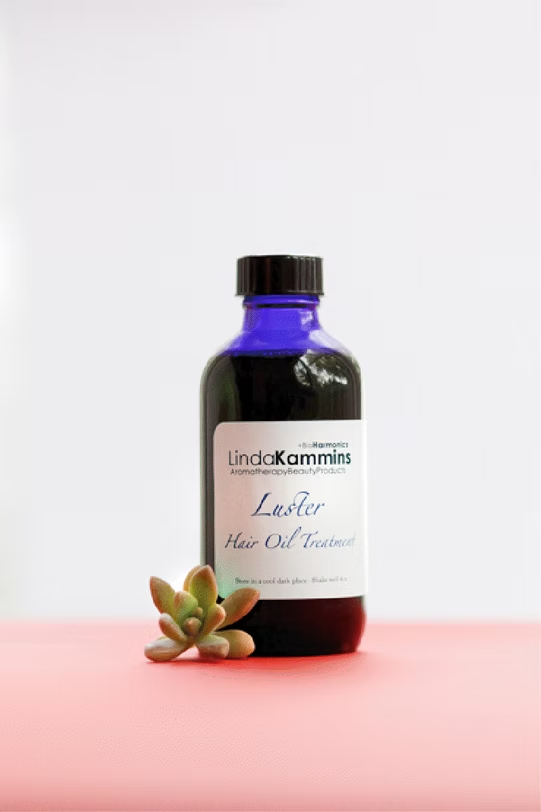
So, when I read about Luster Hair Oil, what interested me most was how naturally it fits into Linda’s larger philosophy of nourishment.
Her materials talk about hair and skin flourishing when nourished with Essential Fatty Acids (EFAs) from within and from quality plant oils. Ingredients like unrefined coconut, hemp seed, flaxseed, and wheat germ oils are highlighted for their role in supporting cell membranes and helping the body absorb nutrients. The underlying idea is that hair and skin don’t just want surface gloss. They want meaningful nourishment.
That distinction feels important.
Gloss is cosmetic.
Nourishment is structural.
The beauty world often sells the illusion of health because the illusion is faster. Shine spray is immediate. A silicone-heavy formula can make things look smooth in ten seconds. But nourishment is slower, quieter, and usually less theatrical. It asks for consistency instead of spectacle.
That’s partly why I’m drawn to products like Luster Hair Oil in theory. Not because I expect a miracle from a bottle, but because I appreciate products designed around the idea that care is cumulative. A few drops here, a little scalp attention there, a formula built with thought rather than noise, that kind of approach feels more believable to me.
Linda also puts unusual emphasis on freshness and quality, especially when talking about EFA oils. She notes that not all oils are created equal and that high-quality, fresh oils matter, with some best stored refrigerated. I weirdly love that detail because it is so unglamorous and specific. It doesn’t sound like marketing. It sounds like someone who has been paying attention for decades and wants people to understand that ingredients are not just names on a label. They have condition, integrity, lifespan.
The Garden Metaphor Actually Works
Usually when brands compare the body to nature, I roll my eyes a little. Not because the idea is bad, but because it gets used lazily.
But Linda’s “honor hair and skin like a garden” philosophy actually holds up the more I think about it.
A garden does not respond well to panic. You cannot yell a plant into thriving. You cannot dump random chemicals on it every week and expect serenity.
You pay attention. You notice dryness. You adjust the environment. You feed the soil. You protect what’s fragile. You learn patience.
That is a much nicer framework for beauty than the one a lot of us grew up with, which was basically: identify flaw, attack flaw, buy stronger product, repeat.
The garden approach feels wiser.
It leaves room for observation.
It allows care to be seasonal, intuitive, and responsive.
And it acknowledges something very obvious that beauty marketing often ignores; different people don’t just want different results. They need different kinds of support.
When a Brand Feels Like a Person Made It
This may be my favorite thing about Linda Kammins Aromatherapy Beauty: it feels authored.
Not just manufactured. Authored.
The line includes small-batch, handcrafted products. The formulations are tied to a real biography. The salon history matters. The aromatherapy focus matters. The ingredient choices feel connected to a larger point of view. Even the language around the brand carries the voice of someone who has spent years thinking about healing, balance, beauty, and the emotional effect of what we put on our bodies.
That coherence is rare.
A lot of brands sell products.
Fewer brands communicate a philosophy.
And even fewer make me feel like the philosophy existed before the products did.
That’s the feeling I get here.
Shungite Shampoo doesn’t seem like it was created because the market needed one more shampoo. Luster Hair Oil doesn’t feel like it was added because every brand needs an oil. They feel like natural extensions of Linda’s long relationship with herbs, essential oils, scalp care, skin care, and the search for healthier alternatives in beauty.
What I Notice About the Customer Comments
I always read testimonials with a healthy amount of caution because real people can adore the same product that someone else doesn’t care for at all. But they can still reveal something useful.
The customer comment about the shampoo stood out to me because it wasn’t trying too hard. It focused on simple, concrete things: the shampoo felt clean, fresh, gentle, and effective; the hair stayed nice for days; the lather felt right even without conventional harsh ingredients. That kind of feedback tends to be more persuasive than overly dramatic praise because it sounds like something a real person would actually notice in their own bathroom.
The skincare testimonial also says something meaningful about the broader brand. A customer with allergies who had struggled to find products that didn’t cause a reaction felt happy with the line and appreciated the quick delivery and care behind it. Again, not a wild promise. Just a person relieved to find something their skin seemed to like.
That tone matches the brand itself.
Less hype.
More devotion.

The Beauty Shelf I Want Now
I think what I’m responding to most in Linda Kammins Aromatherapy Beauty is not just the ingredients, though those are interesting. It’s not just the story, though that’s compelling too.
It’s the atmosphere.
Some products make you feel like you’re failing and need to be corrected.
Some products make you feel like your body is a problem to solve.
And some products feel like they were created by someone who respects the fact that hair, skin, scent, mood, and memory all live surprisingly close together.
That’s the category this brand falls into for me.
Shungite Shampoo sounds like the kind of product for someone who is tired of harsh formulas and wants cleansing to feel balanced rather than aggressive.
Luster Hair Oil sounds like the kind of product for someone who understands that softness and shine often begin with nourishment, patience, and better ingredients rather than flashier promises.
And together they represent a beauty philosophy I find myself appreciating more and more: not louder, not trendier, not more extreme.
Just more thoughtful.
The older I get, the more suspicious I become of products that try to dazzle me into submission. I don’t need my shampoo to sound like a sci-fi weapon. I don’t need my hair oil to promise transcendence. I just want to feel like the person who made it understands that care should actually feel caring.
That may be why Linda Kammins’ approach lingers in my mind.
It began with a young beauty student recoiling from toxic salon smells and deciding there had to be a healthier path. It continued through decades of salon work, research, aromatherapy, and small-batch formulation. And now it shows up in products built around plants, minerals, essential oils, and the steady belief that beauty works best when life is treated with balance.
Which, honestly, is a lovely thought to take back into the shower.
Not everything on the bathroom shelf has to be loud.
Some things can just be wise.