

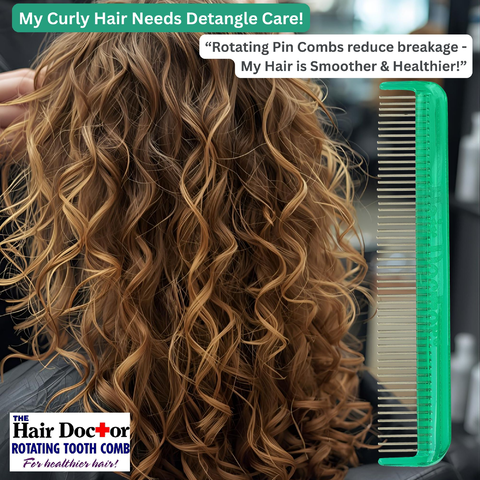
Every time you wash your hair and comb it, you get the same annoying knot. Some people think that the sharp tear that happens all the time is merely a necessary evil, like “shedding” or the price of having long, thick, or textured hair. This is an extremely bad idea that costs a lot of money. That sound isn’t normal hair loss; it’s a mechanical break, which is the sound of the hair fiber breaking at its weakest point. This small amount of damage every day is the biggest thing that inhibits people from getting longer, thicker hair. It makes the ends thinner, makes the hair frizzy, and makes it look like growth has stopped.
There are other things than expensive serums and conditioners that can help your hair look its best. These things just strive to fix a cycle of damage that keeps happening. When it comes to untangling, the actual answer is to change how physics works. This entails fixing the specific mechanical issue with the fixed-tooth comb, which can be found in practically every bathroom. In order to completely appreciate the solution, one must first have a deep awareness of how weak the hair fiber structure is.
Part 1: The Biomechanical Crisis of Wet Hair
A significant portion of hair is composed of keratin proteins, which are long, intricate fibers that are grouped in a hierarchical structure. Despite the fact that many think it to be extremely robust and resilient, its strength is only maintained for a short period of time. There are three layers that make up the hair shaft: the medulla, which is the innermost core and is frequently absent in finer hair; the cortex, which is the major structural body that provides hair with its elasticity and tensile strength; and the cuticle, which is the outermost layer of overlapping scales that protects hair.
As a result of the fact that the cortex is where the majority of the hair’s links are located, your hair is most prone to breaking there.
1. Disulfide Bonds: Robust, covalent bonds that give hair its permanent shape and make it robust against heat and chemicals.
2. Ionic (Salt) Bonds: These are electrostatic forces that help hold a structure together and alter when the pH varies.
The most prevalent but weakest temporary connections that hold the helical keratin chains together and give hair its shape are hydrogen bonds.
The Water-Weakened State: Hygral Fatigue
When hair becomes wet, it changes in a big way. Water molecules, which are strong hydrogen bond acceptors, get into the hair shaft and compete with and temporarily disrupt a large number of the internal keratin-keratin hydrogen bonds. This is called the plasticization of the keratin filament.
The hair fiber changes a lot when it is plasticized:
· Lower Tensile Strength: A dry strand is very strong, but a wet strand loses about 20–30% of its maximum breaking strength.
· A greater degree of elasticity: The fiber becomes extremely flexible and can stretch up to thirty percent of its initial length without splitting. It is possible for this additional elasticity to be deceiving because it gives the impression that the hair is robust, but in reality, it can be easily pushed beyond its yield point.
When you pull a stiff, fixed-tooth comb through this very elastic, structurally weak wet hair, it causes a lot of stress in a small area. The teeth of the comb can’t get through an interlaced knot, so it creates a fulcrum, which makes the hair strands stretch quickly and then break. This breakdown is scientifically known as impact loading, which is a quick application of force at a high strain rate.
This is much more damaging than a progressive draw (tensile loading). The outcome is not only the loss of hair, but also the physical damage to the cuticle, which makes the surface weaker, increases friction, and makes it more likely to get tangled again in the future. This process is called weathering.
Part II: Why Traditional Detangling Tools Don’t Work
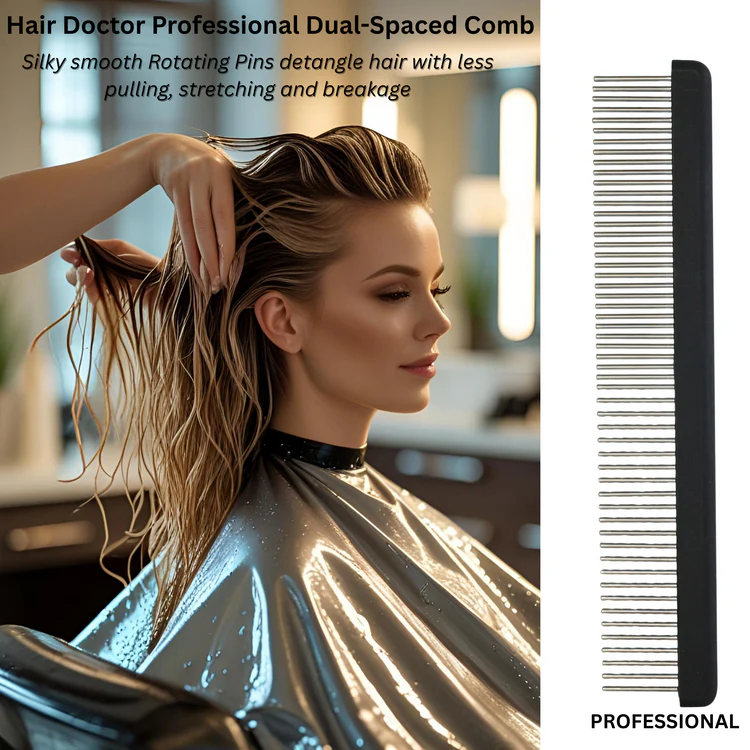
For decades, the wide-tooth comb has been the best way to get rid of tangles in wet hair. It is definitely better than fine-tooth combs or regular brushes, but it is still a static, imprecise tool that simply makes the problem less bad, not better. The science shows the problem with the fixed-tooth design:
• The Rigid Snag Point: When a fixed tooth hits an “inter-fiber knot,” which is a tangle of crossed and looped hairs, it stops right away. This hard, unmovable barrier sends all of the pulling force straight to the strands that are twisted strands, which makes them break. The power is focused almost entirely on the contact point; thus, the hair will break before the comb does.
• Surface Abrasion and Friction: Most ordinary wide-tooth combs, whether they are made of plastic or wood, feature rough edges or microscopic mold seams. These flaws work like sandpaper when they are rubbed over the hair many times, snagging and pulling the tiny, overlapping cuticle scales. This makes the hair-on-comb friction higher, which means the user has to pull harder, which speeds up the breaking cycle and leaves the hair with a rough, dull, frizzy surface.
• Creating Static Charge: Combing with plastic and nylon tools is famous for creating triboelectric charge (static electricity) through friction. This charge makes hair strands push away from each other, which generates “flyaways” and makes it more likely that new, small knots will form right after you untangle your hair. This is a modest but persistent source of stress on the machine.
Part III: The Engineering Revolution of Technology for Rotating Teeth
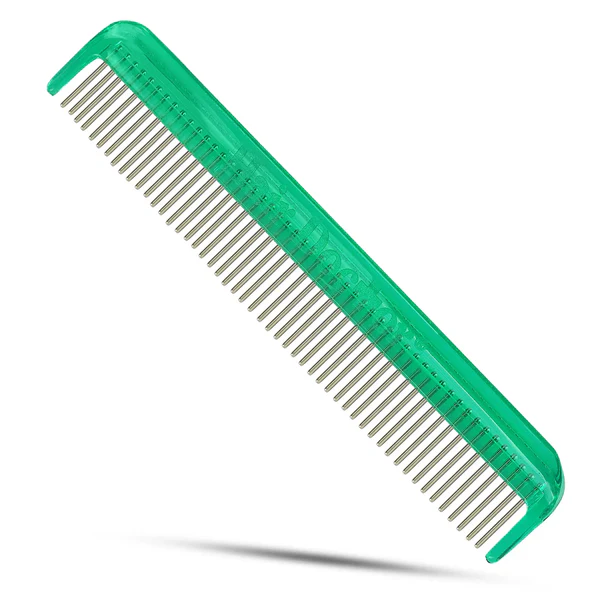
We need to radically alter the way in which the combing tool and the knotted hair fiber interact in order to find a solution to the problem of detangling and breaking hair. Changing how you comb your hair from a static, rough drag to a smooth, friction-reducing slide is the concept that underpins the Hair Doctor Rotating Teeth Combs. These combs are designed to make things easier for you.
The main technique is based on two major mechanical breakthroughs:
- Dynamic Stress Dispersion (The 360° Roll)
The firm, smooth, stainless-steel pins of the rotating comb are installed such that they can freely rotate 360 degrees within the spine. This is different from a fixed comb tooth, which acts as a roadblock. When a pin hits an “inter-fiber knot,” it doesn’t stop; it rolls instead. This rolling motion is the physical key to avoiding damage. The pin’s rotation spreads out the kinetic energy of the comb stroke. The pin tries to uncoil the knot by rolling against it instead of putting all of its force on one location. This changes the event from one that is stressful and breaking to one that is relaxing and low-stress. Reduces Tensile Stress: The pin rolls, which lower the total coefficient of friction between the pin and the hair mass. This means that the user has to pull much less to get the tangle out. The hair fiber is less likely to extend beyond its key yield point of 30% elongation, which stops the internal molecular fractures that cause snapping.
- Improved Material Science and Qualities That Keep Things from Getting Static
The way the mechanism turns is equally as crucial as the material and pin design: Stainless steel pins:
The pins are constructed of stainless steel that is very smooth and of great quality. This metal surface makes it much less likely for hair to become stuck in the comb than plastic does. The steel is also naturally anti-static, which means it doesn’t keep a charge as well and doesn’t make or hold a charge as well. This stops the flyaways and frizz that happen after you untangle your hair from happening again.
Tips that are smooth and round.
The ends of the pins are round and smooth all the way around. This keeps the harsh mold lines on plastic combs from getting caught on and hurting the sensitive cuticle layer, which happens a lot. This smooth touch retains the hair’s natural ability to repel water and keeps the cuticle scales flat. This makes the hair shine more and keeps water from getting in, which can make the cortex weaker.
Better scalp health: The smooth, rounded pins gently massage the scalp, which promotes blood flow and gives oxygen and nutrients to the hair follicle, which is the living root structure.

This mild massage is a basic, non-invasive way to improve the health and growth cycle of your hair. In conclusion:
Putting money into mechanical integrity. The first step toward reaching your hair health goals is to understand that detangling is a physics problem, not just a cosmetic one. Products give short-term, surface-level improvements, but the tool decides the fiber’s mechanical fate.
Every Hair Doctor Rotating Teeth Comb, from the Silky Smooth Rotating Stainless Teeth with its dual-spaced pins to the wide-set Vanity Comb for the most powerful detangling on the thickest, curliest hair, shows a devotion to mechanical integrity. When you choose the technology of rotation, you’re not just reducing damage; you’re putting in place a better mechanical system that has been scientifically engineered to get rid of the main reason hair breaks when it’s wet and most fragile.
This one, well-informed choice turns the detangling process from a stressful, damaging task into a pain-free, follicle-stimulating act of self-care that keeps your hair long. It is the necessary investment to make sure that every strand stays strong, undamaged, and ready to reach its full, amazing potential.
Stop the cycle of breaking today.